
Understanding Student Misbehavior in the Classroom: The Escalation Accountability Sequence™

Updated: Feb 26

A New Framework for Understanding Student Misbehavior in the Classroom
Table of Contents
A Clearer Way to Understand Escalation
Have you ever been in the middle of a full-blown classroom crisis?
A student is yelling. Something flies across the room. The other students freeze. Your heart starts pounding. And in the middle of all that chaos, you’re trying to make split-second decisions.
Do I speak?
What should I say?
Do I step closer, or give space?
Should I call for support, or wait?
If you’ve been teaching long enough, you’ve lived this moment. And if we’re honest, in situations like these, it’s not just the student's behavior that makes the situation stressful. They’re also stressful because, in the midst of the crisis, we’re not always sure what will come next.
For years, I used the language and principles of The Crisis Cycle to make sense of these moments. And this framework helped me a lot. It gave me structure and clarity; and it reminded me that escalations tend to follow a predictable pattern.
But over time, I realized that several parts of The Crisis Cycle were nearly impossible to see while the crisis was unfolding.
Some phases were too brief, too subtle, or only visible in hindsight. And when adrenaline was high, the room was loud, and my heart was racing, I didn't need nuance. I needed large, obvious phases that would help me track the trajectory of the crisis in real time.
That’s why I created The Escalation Accountability Sequence™.
Why Correction During Escalation Fails
Here’s the sticking point: a student explodes, and our training kicks in. We take swift and immediate action to correct the student, control the behavior, and issue consequences, if necessary.
But when a student is emotionally dysregulated, they are not in a learning state. So, trying to correct behavior or issue consequences in the middle of emotional overload often makes the situation worse, not better. Under these circumstances, our training often works against us.
It’s not that correcting or administering consequences is wrong. It’s that the timing is off.
When a student is highly escalated, we have two main goals. First, we want to de-escalate the student as quickly and as safely as possible; and second, we want to administer discipline in an effort to teach the student accountability so that the behavior won't happen again.
These goals are in competition with one another; and we are often unsure of which to use. So we use both at the same time, randomly oscillating between the two hoping that one of them works.
But the Escalation Accountability Sequence™ gives us a clear understanding of student misbehavior in the classroom; and with this understanding we are able to achieve both goals by clarifying which goal to work towards and when.
On the escalation side of the sequence, our role is clear. Protect safety. Reduce intensity. Preserve connection. Stabilize the environment. That’s it. We are not teaching lessons, rather we are creating conditions where accountability can eventually happen.
Once the student has recovered and is back at their emotional baseline, this is when we pivot. It is at this point in the sequence that we pause privileges, support reflection, and teach replacement behaviors. This is when we teach accountability.
De-escalation and accountability are not opposites. They are not in competition with one another. They are sequential. One prepares the way for the other and the two goals work together synergistically to achieve the overarching objective of lasting behavior change.
Now let’s break down the Escalation Accountability Sequence™.
The Escalation Accountability Sequence™
Figure 1 below is an image of the Escalation Accountability Sequence™.
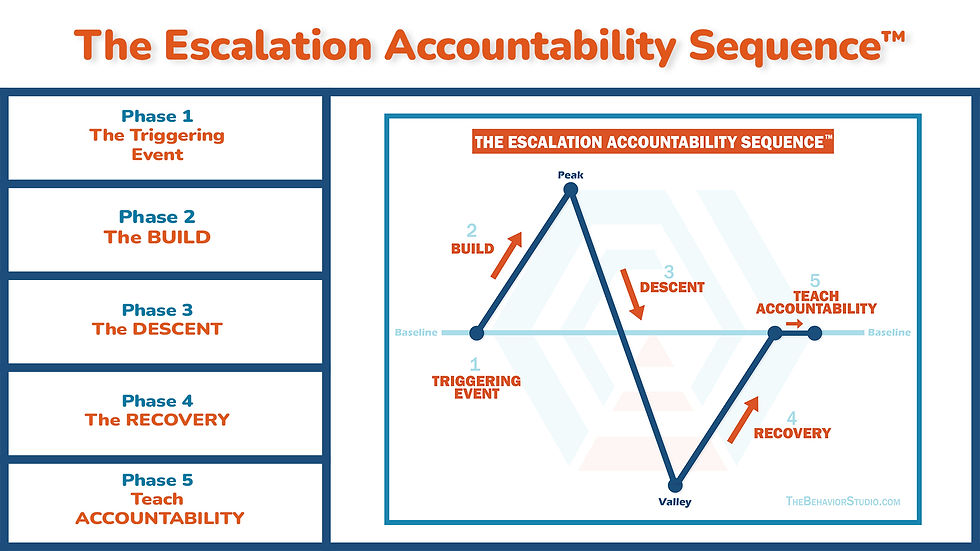
It is made up of five-phases that are anchored on a baseline.
The baseline is not a phase. It is a marker that serves two purposes.
First, it represents the student’s baseline emotional state, the place where their nervous system is regulated, they can think clearly, they are ready and able to learn, and problem-solving is possible.
To discover the baseline emotional state of your student ask yourself this questions:
When everything is going well, what is my student's usual emotional state?
Your answer to this question will give you a very good idea of your student's emotional baseline. If you do not know the answer to this question this is a good place to start in your behavior change process.
Second, the baseline represents the timeline. It allows us to see how behavior unfold as the crisis progresses. When we anchor to the baseline, we stop treating escalation as a single explosive event and start seeing it as movement away from and back towards the baseline.
When we are in the middle of a crisis, it can feel like everything is happening all at once. But when we understand and use the baseline as our reference point, we can ask two much more informative questions:
Where are we in the process?
Are we moving away from regulation, or back toward it?
It is important to understand that the sequence is not a script that predicts exactly how a student will behave during a crisis. Instead, it helps us determine where we are in the process by looking at the student’s current behavior in relation to their emotional baseline, the amount of time that has passed, and the behaviors that have already occurred.
Everything in the Escalation Accountability Sequence™ is anchored to the baseline. The baseline serves as the primary reference point, allowing us to measure movement away from regulation and movement back toward it.
Now, with the baseline clearly established, let’s overview the 5-phases.
Phase 1: The Triggering Event
A triggering event is any event, big or small, positive or negative, known or unknown, that causes a student to emotionally dysregulate,
A student is considered emotionally dysregulated when they have lost control of their emotions to the degree that they can no longer learn, they are significantly disrupting learning for others, or both.
Sometimes the triggering event is obvious, such as a public correction, a denied request, or a peer conflict that escalates quickly. Other times, the trigger is far less visible. It might be a tone of voice, a look from a peer, a task that feels overwhelming, or even something that happened outside of our classroom that we know nothing about.
The size of the trigger does not always match the size of the reaction, and that mismatch is often what confuses us.
It is important to understand, however, that the triggering event is not yet full escalation. It simply marks the beginning of movement away from baseline; the point where emotional intensity starts to rise and the student’s capacity for flexible thinking begins to narrow.
If we learn to notice triggering events early, we give ourselves the greatest chance to abbreviate the crisis or stop it altogether. With our deep understanding of the link between student behavior and the classroom, we may be able to adjust the environment, reduce demands, lower our voice, provide reassurance, or simply give space before intensity builds.
Early recognition expands our options.
Once we move beyond the triggering event and deeper into escalation, our choices become more limited and our role shifts more heavily toward stabilization.
Phase 2: The Build
The build begins when emotional intensity continues to rise after the triggering event. At this point, the student is moving further away from baseline, and their ability to think flexibly, problem-solve, or respond to correction is significantly reduced.
You know you are in the build phase because behavior is beginning to increase in frequency and intensity.
You will see behaviors like arguing, extreme defiance, eloping from class, and verbal and physical aggression. The student’s sympathetic nervous system is now driving the moment. Logic has narrowed or disappeared altogether and emotion has taken the lead.
During the build phase, attempts to correct, reason with, or impose consequences often intensify the situation. The student is not in a learning state. They are in a survival response. So they are likely to see these actions as threats to their autonomy and escalate in an effort to maintain control. As a result a power struggle ensues.
This is where our role shifts more heavily toward stabilization.
Our tone matters. Our proximity matters. The amount of language we use matters. The goal is not to win. The goal is not to teach a lesson. The goal is to prevent further movement away from baseline.
Phase 3: The Descent
During the descent phase, the intensity of the situation stops rising and begins to level off. You know the descent has started when the student’s behaviors begin to decrease in both frequency and intensity.
The student may still be upset, but their movement is slowing. This is our sign that the parasympathetic nervous system has kicked in and is beginning to calm the body.
It is important to understand that this phase crosses the baseline. If you look at Figure 2 below, you will see that halfway through the descent phase, the student nears and then reaches baseline. It is at this point that the visible behaviors will have completely stopped.

Because of this, this moment often misleads us.
When the behaviors stop, we assume the crisis is over and accountability can begin. But the truth is the student is still emotionally fragile. If we begin addressing accountability too soon, we risk restarting the crisis.
At some point during the descent phase, the student will drop below baseline. The parasympathetic nervous system has kicked in to calm the brain and body down. As a result, the student’s affect will fall below their baseline emotional state. This happens because when the brain moves through a significant emotional upheaval, it needs time to recover.
Once below their baseline, the student may withdraw, avoid eye contact, sit in silence, cry, or even fall asleep. This is not defiance. It is the nervous system recalibrating.
Because the student is still emotionally fragile, during the descent phase, we continue to prioritize stabilization. Most importantly, we protect the student in order to guard against any additional triggering events. We are almost out of the crisis, we do not want anything to inadvertently come along and restart it.
Even though the crisis appears over, the nervous system is still settling. Pushing accountability prematurely can reignite escalation. So do not rush reflections. Do not demand apologies. Do not revisit the incident yet. And do not shame the student.
Our role here is patience.
Phase 4: The Recovery
During the recovery phase, the student is returning to their baseline emotional state.
You know the recovery phase has begun when the student’s affect begins to rise back toward their emotional baseline. If they were asleep, they wake up. If they were silent, they begin to talk. If they were crying, they stop. If they were withdrawn, they start to reengage.
At first glance, it may appear that the brain and nervous system are fully stabilized. But we do not want to be misled by this initial shift.
Yes, the student’s thinking has returned. They can process language again. They are capable of reflection and learning. And because of that, it can be tempting to begin the accountability process immediately.
However, the thinking brain has only just regained control. In the first few minutes after full recovery, that control is still fragile. For this reason, we will wait at least ten minutes before beginning the reflection portion of accountability. This allows the thinking brain time to firmly reestablish control and it also allows us to recover from the incident as well.
During this time, however, we will begin the consequence portion of the accountability phase by pausing privileges.
The student should be given as much time as they need to recover in a protected space that is safe, quiet, and supportive. But, while they are recovering, access to privileges remains paused until the accountability phase is complete.
For example, in my classroom, I allow students to return to their desks and put their heads down. I leave them alone and protect them from being bothered by their peers. At the same time, they do not have access to preferred activities or items, and they temporarily lose access to breaks such as recess, lunch, or passing periods until the accountability phase is complete.
Phase 5: Teaching Accountability
This is where we intentionally shift from stabilization to reflection and instruction.
By the time we reach this phase, consequences have already been administered. Privileges have been paused, and access to preferred items, activities, and freedoms has been temporarily removed.
If we stop here, the student may experience loss, but they will not have learned what to do differently, and we will likely find ourselves in the same situation again.
Our two goals during the accountability phase are clear: help the student reflect on and take responsibility for their behavior, and explicitly teach a more appropriate behavior they can use in the future.
To accomplish this, we will guide the student through a structured behavior reflection and review the Behavior Response Flow™ - the concrete steps the student must follow to demonstrate the desired behavior. If a Behavior Response Flow™ has not yet been created, this is the time to develop one as part of the reflection process.
After the behavior reflection and review of the response flow is complete, assign the student a short accountability task that is tied directly to the desired behavior and the response flow.
Examples of accountability tasks include a short written reflection, copying and explaining a classroom expectation, completing a structured reflection sheet, or rehearsing the replacement behavior.
The accountability task does not need to be lengthy (1-5 minutes depending on age and cognitive level of the student), but it must be purposeful and clearly tied to the skill being taught.
If the behavior repeats, the accountability task will increases in length or complexity. Short tasks can be stacked so that the cost of repeating the undesired behavior grows over time. This progression encourages the student to recognize that using the replacement behavior is the more effective and efficient choice.
Privileges are to remain paused until the accountability task is complete. Once the student has reflected, reviewed the Behavior Response Flow™, and completed the accountability task, access to privileges should be immediately restored.
Teaching accountability after a behavior crisis is not about punishment alone.
Rather, it's about pairing consequences with explicit instruction so that the student leaves the incident better equipped to manage the moment next time.


The Escalation Accountability Sequence™ provides the timing and structure for responding to crisis behavior. If this idea resonated with you, explore how the Escalation Accountability Sequence™ connects to the rest of the B.E.S.T. Behavior Transformation System™.
Safety-Focused De-Escalation
Teaching Accountability
Engineering the Environment


Comments